Gorseth Kernow,
The Gorseth Of Cornwall
1928-2004
Saturday 4th September 2004
at Lemon Quay Truro.
Truro grew up on the trade route from the Gannel to the Fal nestled between
two rivers, the Kenwyn and the Allen. It is possible that the word Truro
derives from three rivers as there is a third river, the Glasteinan,
no more than a trickle these days, which meanders down under the Trafalgar
area. Pydar Street is probably the oldest street in the town and led
travellers down to a settlement near a Cornish cross which is believed
to have been erected by the Dominican friars who settled in Truro c.1250.
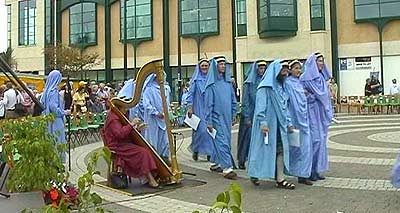
Gorseth 2004 - Lemon Quay, Truro
The town once had a castle and it is highly likely it was built on the
ruins of a much earlier earthwork. It was Richard de Lucy, a henchman
of Alan of Brittany, Earl of Cornwall who was credited with granting
Truro its first charter c1153. In 1327 Truro became a stannary town
which would have improved its prosperity with the twice yearly coinages.
The coinage hall was built at the end of Middle Row but was demolished
in the mid nineteenth century. The town was actually set on fire in
1404 in a fight with the French who thought nothing of coming up the
Truro River!
Truro has many famous sons, some born here, some who were sent here
to be educated at the Grammar School, which was founded in 1547. Among
the latter are Humphrey Davey and Goldsworthy Gurney. Among those born
in Truro are Richard and John Lander who traced the course of the Niger,
Henry Bone the enamellist and miniaturist, Samuel Foote the actor and
satirist,and Henry Martyn the missionary.
There is a fine wide main street in Truro, as when Middle Row was pulled
down it was not replaced. The Municipal Buildings are in the Italian
style and were designed by Christopher Eales. They house the Hall for
Cornwall on Back Quay. The imposing Coinage Hall on the old site was
built in Tudor style as a bank. There are many Silvanus Trevail designed
buildings, though the Post Office in High Cross was demolished some
years ago. Walsingham Place is attributed to Philip Sambell, who was
also the architect of other buildings, including the Museum and Truro
Methodist Church, all remarkable as he was a deaf mute.
In 1877 Truro was granted city status and the old St. Mary’s Church
was pulled down to make way for the new cathedral. The south aisle was
retained however and still serves the people as their parish church
today.
As always the Gorseth Council is most grateful to Truro City Council,
Carrick District Council, All at Lemon Street Market, the Congregation
and the Minister at St Mary Clement Methodist Church Truro, Truro Old
Cornwall Society, Truro Women’s Institute and other local organisations
and volunteers for welcoming us so enthusiastically and giving us so
much practical help.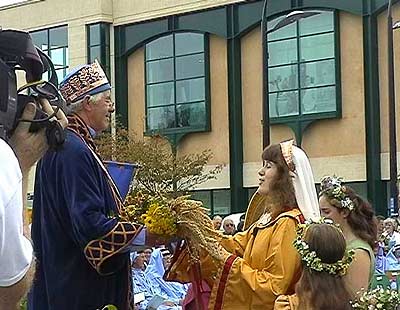
In ancient Celtic times Bards were honoured for their scholarship in poetry, literature, art, music, history and folklore. In them rested the traditions and history of the people. The creation of the Gorseth, or gathering, of the Bards of Cornwall, followed the 18t century revival of the Bardic tradition in Wales. Cornwall’s ceremony and organisation are similar to, but on a smaller scale than those in Wales, where the Gorseth is linked to the National Eisteddfod. The Gorseth is non-political, non-religious and non-profit-making. It exists solely to uphold the Celtic traditions of Cornwall and to honour men and women who have made outstanding contributions to Cornwall and its ancient culture, history and language.
|
